These are moments that invite us to slow down, notice, and reconnect with the living world around us. Some become stories shared during Kinwood Echoes Nature Connection Walks and read-aloud experiences. Others simply remain quiet reminders that nature is always speaking, if we take the time to listen.
Life Beneath Our Feet
One July morning, after a rainy day, dozens of tiny mushrooms appeared across a quiet patch of our backyard—small, delicate, and easy to overlook among the grass. Their sudden appearance was a delight to the eyes, as though the rain had quietly scattered little buttons across the ground.
Yet their story had begun long before we could see them. What rises above the soil is only the visible fruiting body of a much larger fungal organism. Beneath the ground, fine threads called mycelium spread through the soil decaying organic matter, carrying out their quiet work.
Fungi help break down fallen leaves, wood, and other natural material, returning nutrients to the soil. Through these largely unseen processes, they contribute to the health and renewal of the surrounding ecosystem.
The mushrooms themselves may remain for only a short time. They emerge, release their spores, and gradually disappear. Yet the hidden fungal network beneath the surface can continue living and working long after the mushrooms have faded.
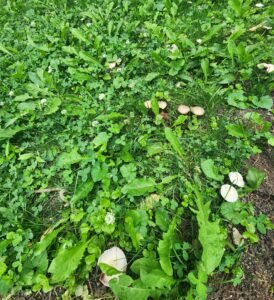
Tiny mushrooms emerging after the rain—a glimpse of the hidden fungal network quietly at work below the soil.
Their brief arrival offered a gentle reminder:
Not all growth is visible.
Sometimes, life is forming quietly beneath the surface, gathering what it needs before revealing itself.
It also made me think about the way we care for our yards. When every corner is closely mown, cleared, or treated, many small forms of life lose the space they need.
Small acts of sustainability often begin at home. Leaving one little patch of a garden less manicured and undisturbed can allow fungi, insects, and countless unseen organisms to continue their essential work.
Nature does not always need us to manage more.
Sometimes, it simply needs us to make room.
At Kinwood Echoes, everyday encounters like this become invitations to pause, notice, and reconnect with the living world already present around us.
A Gentle Invitation
Is there a small corner of your yard or garden that could be left a little quieter?
You may be surprised by what begins to emerge.
What began as a few young native plants has gradually become a small but thriving urban habitat.
Last year, through Mississauga’s Blooming Boulevards initiative, I planted several native species along the boulevard beside our home. At first, they were simply young plants finding their place in the soil. Today, they continue to surprise me with each new bloom and each new visitor they welcome.
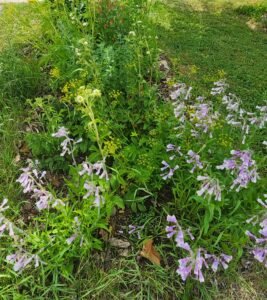
Our growing boulevard garden in June—a small urban space gradually becoming a habitat for pollinators and other wildlife.
Spring began with the cheerful yellow flowers of Golden Alexander and the graceful blossoms of Wild Columbine. They were among the first to offer nectar and pollen to bees, butterflies, and other pollinators emerging from their winter rest.
Soon after, a gentle rain transformed the garden.
The following morning, the soil was still damp beneath my feet. The familiar scent of wet earth filled the air, tiny droplets rested on every petal, and the flowers seemed to greet the day with renewed colour and fragrance.
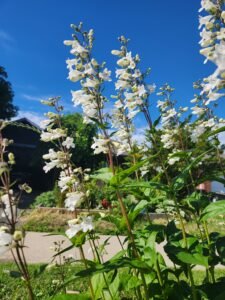
The Hairy Beardtongue quietly came into bloom alongside the Iris. While the Iris drew the eye with its rich velvety petals, the Hairy Beardtongue offered nourishment to pollinators moving through the landscape.
As the weeks passed, the story continued.
The Hairy Beardtongue was joined by Foxglove Beardtongue and Prairie Cinquefoil, adding new colours, textures, and relationships to this growing space.
With every flower came new visitors.
Bees paused to gather nectar. Butterflies moved gently between blossoms. Hoverflies, beetles, and many other small beings became part of the daily rhythm of the garden.
One of the greatest joys of growing native plants is watching these relationships unfold.
A flower opens.
An insect arrives.
Birds follow.
Seeds begin to form.
What once appeared to be an ordinary strip of land slowly becomes part of something much larger.
Native plants do far more than brighten our neighbourhoods. Having evolved alongside local wildlife, they provide food, shelter, and habitat for the many beings that share our cities with us.
This little boulevard garden reminds me that meaningful change does not always require large spaces.
Sometimes, a single native plant becomes the beginning of a healthier urban ecosystem.
Sometimes, a boulevard becomes a habitat.
Sometimes, a small act of stewardship inspires another.
Through Kinwood Echoes, I often invite people to pause, notice, and reconnect with nature. Tending this boulevard garden has become another way of practising that invitation.
And somehow, as the garden fills with life, so does the heart.
A Gentle Invitation
Perhaps there is a small corner near your home—a boulevard, front yard, backyard, or balcony—waiting to welcome a native plant.
Small spaces can nurture remarkable connections.
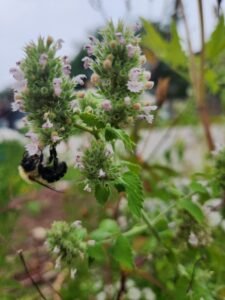
From mid-June to early July, our mulberry tree quietly transforms.
What was once a canopy of green leaves slowly fills with clusters of fruit, ripening day by day until the branches are dotted with deep purple berries.
The tree does not keep its harvest to itself.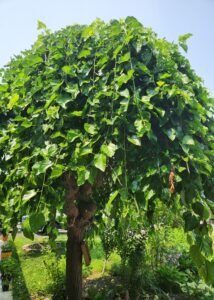
It offers nourishment to birds, squirrels, insects, and, as part of this little ecosystem, to us as well.
Our family enjoys a handful, always leaving plenty behind for the many other beings that depend on it.
For the children, however, the harvest is the true adventure.
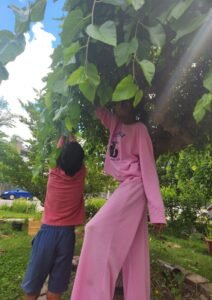
Harvest Begins
The joy of reaching, picking, and discovering fruit straight from the tree.
It begins with noticing the tiny green fruits appear, followed by the daily anticipation of watching them change colour. Soon comes the excitement of reaching up to the branches, carefully picking the ripest berries, collecting them into bowls, washing them, and finally tasting them fresh from the tree.
Purple fingers and stained smiles become part of the experience.
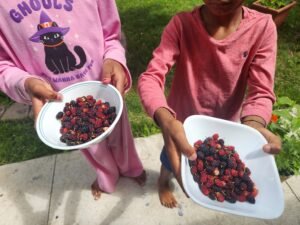
A Shared Harvest
Freshly picked mulberries—enough for our family, with plenty left behind for the birds and other wildlife.
These moments remind me that nature connection doesn’t always happen on a forest trail or in a protected park.
Sometimes it happens beneath a fruit tree in your own yard.
Sometimes it begins with watching a flower become a fruit.
Sometimes it grows from the simple joy of harvesting food together.
For children, these experiences quietly build an understanding that food has a story. It grows with the seasons, depends on healthy soil, rain, sunshine, pollinators, and time. They begin to understand that they are not separate from nature, but participants within it.
Small acts of sustainability often begin at home. Growing even one fruit tree or food-bearing plant can nourish not only our families but also the birds, pollinators, and wildlife that share our neighbourhoods.
Each summer, our mulberry tree reminds us that abundance is something to be shared.
And perhaps that is one of nature’s quietest lessons.
A Gentle Invitation
If you’re fortunate enough to have a fruit tree or berry bush nearby, spend a little time beneath it this season.
Notice who else has come to enjoy the harvest.
You may discover that you’re sharing far more than fruit.